
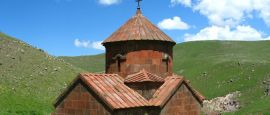

Armenia Weather, climate and geography
Weather & climate
Armenia has a continental climate, characterised by hot summers and cold winters, with significant variations due to altitude. Because much of the country lies at high elevation, temperatures can differ noticeably between valleys and mountain regions.
Spring runs from March to May and is one of the most pleasant times to visit. In Yerevan and lower-lying areas, daytime temperatures typically range from 15–25°C (59–77°F). Mountain regions remain cooler, especially in early spring, and snow may still linger at higher elevations.
Summer lasts from June to September and can be hot, particularly in the Ararat plain and Yerevan, where temperatures frequently reach 30–35°C (86–95°F) and occasionally higher in July and August. Evenings are generally cooler, especially in elevated areas such as Dilijan or around Lake Sevan.
Autumn, from October to November, brings mild and stable weather. Daytime temperatures in the capital usually range between 15–25°C (59–77°F) in early autumn, gradually cooling as winter approaches. This season is often considered ideal for travel, with clear skies and harvest scenery in wine-producing regions.
Winter extends from December to February and can be cold. In Yerevan, temperatures typically range from -5°C to 5°C (23–41°F), though colder spells do occur. Mountain areas experience heavier snowfall and lower temperatures, particularly in ski regions such as Tsaghkadzor.
Overall, Armenia experiences warm, dry summers and cold winters, with spring and autumn offering the most comfortable conditions for sightseeing.
Clothing needs in Armenia vary considerably with the seasons and altitude. During the summer months (June to September), lightweight clothing is suitable for most lowland areas, particularly in Yerevan and the Ararat plain where temperatures can be high. However, evenings are often cooler, especially in elevated regions such as Lake Sevan or Dilijan, so a light jacket or sweater is advisable.
Spring (March to May) and autumn (October to November) can bring changeable conditions. Layered clothing works best, allowing visitors to adapt to fluctuating daytime and evening temperatures. These seasons are generally mild, but cooler mornings and nights are common, particularly outside the capital.
Winter (December to February) can be cold, especially in mountainous areas where temperatures frequently fall below freezing and snowfall is common. Warm coats, insulated footwear and winter accessories are necessary if travelling during this period, particularly for those heading to higher elevations or ski areas.
Rainfall is most likely in spring and late autumn, especially in northern and mountainous regions. A light waterproof jacket or compact umbrella is useful during these months. In higher altitudes, weather conditions can change rapidly, so practical outerwear is recommended when hiking or travelling outside urban centres.
Overall, visitors should plan for strong sunshine in summer, cooler evenings at altitude and potentially cold winters, with flexible layers providing the greatest comfort throughout the year.
Geography
Armenia is a landlocked country in the South Caucasus, situated at the crossroads of eastern Europe and western Asia. It shares borders with Georgia to the north, Azerbaijan to the east, Iran to the south and Turkey to the west. Despite its relatively small size, Armenia's terrain is strikingly varied and overwhelmingly mountainous.
Much of the country lies at high altitude, with an average elevation of around 1,800 metres (5,905 ft) above sea level. The landscape is dominated by rugged mountain ranges, deep river gorges and elevated plateaus. Forested hills characterise the northeast, particularly around Dilijan, while the south becomes increasingly dramatic, with canyon landscapes such as the Vorotan Gorge.
Armenia's highest point is Mount Aragats at 4,090 metres (13,419 ft), a massive volcanic mountain northwest of Yerevan that attracts hikers during the warmer months. The lowest point lies in the Aras River valley at approximately 375 metres (1,230 ft) above sea level, near the border with Iran.
One of the country's defining natural features is Lake Sevan, one of the largest high-altitude freshwater lakes in the world. Sitting at around 1,900 metres (6,234 ft), it plays an important ecological and cultural role and offers a rare expanse of open water in an otherwise mountainous landscape.
Overall, Armenia's geography is defined by height, stone and dramatic relief — a country where roads twist through passes, monasteries cling to cliffs and wide horizons stretch across highland skies.
Do you have any Feedback about this page?
© 2026 Columbus Travel Media Ltd. All rights reserved. No part of this site may be reproduced without our written permission, click here for information on Columbus Content Solutions.



 You know where