
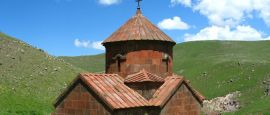


In northeastern Armenia, Dilijan National Park is known for its forested hills, clear mountain air and well-marked hiking trails. Often nicknamed the "Armenian Switzerland", the area combines alpine scenery with hidden monasteries such as Haghartsin and Goshavank. The town of Dilijan itself has a relaxed, almost Alpine character, making it a popular retreat from Yerevan.
Book and Go

Latest features
Armenia things to see and do
Dilijan National Park
Echmiadzin
Often described as the spiritual heart of Armenia, Echmiadzin is home to the Mother See of the Armenian Apostolic Church. The cathedral complex, a UNESCO World Heritage Site, dates back to the early 4th century and is regarded as the world's oldest state-built Christian cathedral.
Garni Temple
Garni Temple is the only surviving Greco-Roman colonnaded temple in the region. Set above the dramatic basalt formations of the Azat Gorge, its classical symmetry contrasts strikingly with Armenia's predominantly Christian architecture. The surrounding cliffs, known as the "Symphony of Stones", add to the site's theatrical setting.
Geghard Monastery
Located about 40km east of Yerevan in the Azat River Gorge, Geghard is partly carved into the surrounding cliffs. Candlelight flickers against volcanic stone, and the rock-hewn chambers carry a haunting resonance when hymns are sung.
Gyumri
Gyumri is the country's second-largest city and its cultural heart. Distinguished by 19th-century black-stone buildings and broad squares, the city has a strong artistic tradition and a famously dry sense of humour. Despite the devastating 1988 earthquake, Gyumri has rebuilt with resilience and retains a distinct, creative identity.
Haghpat Monastery
Haghpat is a UNESCO-listed complex near the Georgian border. It dates from the 10th century. Once an important religious and educational centre, its stone churches and carved khachkars sit peacefully amid mountain scenery, creating an atmosphere of quiet contemplation.
Karahunj
Karahunj is an ancient stone circle set on a windswept plateau near Sisian. Often compared to Stonehenge, its upright basalt stones feature mysterious carved holes whose purpose remains debated. The site's isolation heightens its atmosphere of prehistoric intrigue.
Lake Sevan
A vast high-altitude lake ringed by mountains, Lake Sevan is Armenia's natural centrepiece. In summer, its shores fill with swimmers and picnickers, while the Sevanavank Monastery offers sweeping views across the shimmering water.
Noravank Monastery
In Armenia's Vayots Dzor Province, Noravank rises from within a narrow red-rock canyon, its pale stone walls glowing against the surrounding cliffs. Built in the 13th century, the monastery is famed for its intricate carvings and dramatic two-storey façade.
Sanahin Monastery
Just a few kilometres from Haghpat Monastery, Sanahin forms part of the same UNESCO World Heritage Site. Renowned for its medieval academy and finely carved stonework, the complex rewards slow exploration, with its churches and courtyards framed by highland views.
Tatev Monastery
Located in southern Armenia's Syunik Province, Tatev stands dramatically above the Vorotan Gorge, perched on the edge of a vast canyon. Founded in the 9th century, it was once a major centre of learning. Reached by winding mountain road or the Wings of Tatev cable car, the monastery's cliff-top setting makes it one of the country's most unforgettable sights.
Yerevan
One of the world's oldest continuously inhabited cities, Yerevan blends Soviet-era grandeur with lively café culture and sweeping views of Mount Ararat. Its pink tufa stone buildings glow at sunset, and Republic Square comes alive in the evenings with music and fountains.
Do you have any Feedback about this page?
© 2026 Columbus Travel Media Ltd. All rights reserved. No part of this site may be reproduced without our written permission, click here for information on Columbus Content Solutions.



 You know where