
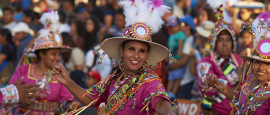


Held each year before Lent, the Carnaval de Oruro is Bolivia's largest festival, combining Catholic traditions with Indigenous Andean beliefs. Thousands of costumed dancers and musicians fill the streets, with the spectacular Diablada (Dance of the Devils) among its highlights. The carnival is recognised by UNESCO as Intangible Cultural Heritage.
Book and Go

Latest features
Bolivia things to see and do
Carnaval de Oruro
Cochabamba
Set in a fertile Andean valley, Cochabamba is known for its mild climate, lively markets and particularly strong culinary tradition. The historic centre surrounds Plaza 14 de Septiembre, while the enormous Cristo de la Concordia statue overlooks the city from Cerro San Pedro. La Cancha, one of Bolivia's largest markets, spreads across several districts south of the centre.
Eduardo Avaroa Andean Fauna National Reserve
In Bolivia's remote southwestern corner, this high-altitude reserve encompasses volcanoes, deserts, geothermal fields and brilliantly coloured lakes. Laguna Colorada is particularly striking, its reddish waters contrasting with white borax deposits and colonies of flamingos. Geysers at Sol de Mañana and the surreal rock formations of the surrounding desert are commonly visited on multi-day journeys from Uyuni.
Inca trails
Ancient routes once linked the Bolivian highlands with the subtropical Yungas, and several survive as trekking trails. El Choro and Takesi are among the best-known, descending from high mountain passes along stretches of pre-Hispanic stone paving into increasingly lush valleys and forests.
Jesuit Missions of Chiquitos
Scattered across the tropical lowlands east of Santa Cruz, the Jesuit Missions of Chiquitos preserve a distinctive group of churches established during the 17th and 18th centuries. Six mission settlements form a UNESCO World Heritage Site, with richly decorated churches combining European religious architecture with local materials and Indigenous craftsmanship. Several towns also maintain a strong tradition of Baroque music.
La Paz
Set in a deep Andean valley beneath the snow-capped peak of Illimani, La Paz is one of the world's highest major cities. Its steep streets encompass busy markets, colonial churches and the museums of Calle Jaén, while the sprawling Mi Teleférico cable-car network provides remarkable views across the city and neighbouring El Alto. The Witches' Market is known for traditional Aymara remedies, herbs and ritual items.
Lake Titicaca and Isla del Sol
Shared with Peru at an altitude of about 3,810m (12,500ft), Lake Titicaca is one of the world's highest large navigable lakes and has deep cultural significance in the Andes. Copacabana is the principal Bolivian lakeside town and departure point for boats to Isla del Sol, where walking trails link small communities, archaeological remains and viewpoints across the intensely blue lake towards the Cordillera Real.
Madidi National Park
Extending from the high Andes into the Amazon basin, Madidi National Park protects an exceptional range of habitats, from cloud forest to tropical rainforest. Rurrenabaque is the principal gateway for excursions into the region, where guided trips focus on rainforest landscapes, rivers and wildlife including monkeys, macaws and numerous other bird species.
Noel Kempff Mercado National Park
Near the Brazilian border in northeastern Bolivia, this vast UNESCO-listed national park protects Amazonian forest, savannah, wetlands and the sandstone cliffs of the Huanchaca Plateau. Numerous waterfalls plunge from the plateau, including the impressive Arco Iris and Federico Ahlfeld falls. Its isolation has helped preserve rich wildlife, but access is difficult and normally requires specialist arrangements.
Potosí
Founded following the discovery of silver at Cerro Rico in the 16th century, Potosí became one of the richest cities in the Spanish Americas. Its historic centre preserves colonial churches, mansions and the Casa Nacional de Moneda, the former royal mint. Cerro Rico still dominates the city skyline and remains closely associated with the extraordinary wealth and harsh labour conditions that shaped Potosí's history.
Salar de Uyuni
Stretching across more than 10,000 sq km (3,860 sq miles), Salar de Uyuni is the world's largest salt flat. During the dry season its immense white surface forms a stark geometric landscape, while seasonal flooding can transform it into a vast natural mirror. Multi-day excursions often continue beyond the salt flat to volcanoes, geothermal fields and the coloured lagoons of the southwestern Altiplano.
Santa Cruz de la Sierra
Bolivia's largest city has a markedly different character from the highland centres, with a warm tropical climate and a low-rise historic core centred on Plaza 24 de Septiembre. The cathedral and surrounding streets contain cafés, restaurants and colonial-era buildings, while the city provides a useful base for exploring the Jesuit mission towns and natural areas of eastern Bolivia.
Sucre
Bolivia's constitutional capital is renowned for its whitewashed colonial architecture and well-preserved historic centre, recognised as a UNESCO World Heritage Site. Churches, monasteries and elegant civic buildings line its compact streets, while the Casa de la Libertad occupies an important place in Bolivian history as the site where the country's declaration of independence was signed in 1825.
Tarija
Southern Bolivia's Tarija region is known for its mild climate, relaxed colonial city and vineyards set at unusually high elevations. Wineries around the Valle de la Concepción produce red, white and sparkling wines as well as singani, Bolivia's distinctive grape spirit. Wine routes through the surrounding valleys combine vineyard visits with small towns and mountain scenery.
Tiwanaku
About 70km (43 miles) west of La Paz, Tiwanaku contains the remains of one of the most important pre-Hispanic civilisations of the Andes. The UNESCO-listed archaeological site includes monumental stone platforms, temples and carved monoliths, together with the celebrated Gateway of the Sun. At its height, Tiwanaku exerted cultural and political influence across a large part of the southern Andes.
Torotoro National Park
Torotoro National Park is characterised by deeply eroded limestone landscapes, canyons, caves and extensive dinosaur footprints preserved in the rock. Trails lead to viewpoints above the dramatic Vergel Canyon, while guided excursions enter the Umajalanta cave system. The park lies in a remote Andean valley north of Potosí and is generally approached from Cochabamba.
Vallegrande and Che Guevara
Vallegrande is closely associated with the final days of revolutionary Che Guevara, who was captured and executed near the village of La Higuera in 1967. His body was taken to Vallegrande and secretly buried nearby, where his remains were discovered in 1997. Sites connected with these events form part of a historical route through the region.
Yungas
East of La Paz, the Andes descend dramatically into the warm, forested valleys of the Yungas. Coroico is the region's principal visitor centre, surrounded by steep green slopes planted with coffee, citrus and coca. The old road descending from the high Andes towards the Yungas, once notorious for its dangerous traffic, is now particularly associated with guided mountain-bike excursions.
Do you have any Feedback about this page?
© 2026 Columbus Travel Media Ltd. All rights reserved. No part of this site may be reproduced without our written permission, click here for information on Columbus Content Solutions.



 You know where